
I am a philosopher, located at the University of St. Gallen. Prior to coming to Switzerland, I had studied Law, Music Performance, Political Theory and Philosophy in Greece and in Germany. Moving between these different fields as well as beyond academic and artistic practices, institutions, contexts, and borders, has shaped my thinking in lasting ways.
My research is grounded in continental philosophy and the tradition of critical theory. Systematically, I draw insights from social and political philosophy, practical philosophy, political theory, and aesthetics. Historically, I engage with theoretical resources ranging from Early Modern thought, the Scottish Enlightenment, and German Idealism to the Frankfurt School, post-war French philosophy, intersectionality, queer theory, and decolonial approaches. These traditions do not form a lineage so much as a constellation: shifting, tense, and unfinished.
In times marked by fragmentation, exclusion, and increasingly exhausted visions of the future, what drives my work is the fragile promise of togetherness that is neither given nor guaranteed, but always at stake. Philosophy matters where it helps us name this stake and where it teaches us how to listen more carefully to plurality and the difference living within it. In this light, Hannah Arendt’s notion of "acting in concert" is more than just a theoretical reference; it is a biographical echo and at the same time an imperative guiding my work.
Department of Philosophy, School of Humanities and Social Sciences (SHSS), University of St. Gallen &
Institute for Business Ethics (IWE-HSG), School of Economics and Political Science (SEPS), University of St. Gallen
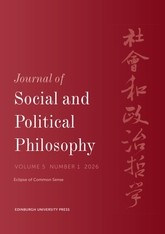
In "Eclipse of Reason" (1947), Max Horkheimer offers a paradigmatic account of the ambivalence of modern reason. Reason cannot simply be discarded, yet it often appears in forms that betray its original emancipatory promise. As Horkheimer writes, “if by enlightenment and intellectual progress we mean the freeing of man from superstitious belief in evil forces, in demons and fairies, in blind fate—in short, the emancipation from fear—then denunciation of what is currently called reason is the greatest service we can render.”
The special issue, "Eclipse of Common Sense", proposes an analogous approach to the concept of common sense. It argues that denouncing what is today rhetorically invoked as “common sense” and operationalized as common-sense policy is a necessary step toward its restoration. Such denunciation does not entail rejecting or ignoring common sense, just as restoration does not imply its uncritical acceptance. Rather, it calls for a critical return to the concept’s intellectual history, an assessment of its theoretical potentials and limitations, and an examination of its political effects, both enabling and constraining. The contributions to this special issue undertake this task collectively by pursuing three interrelated aims: they analyze the conceptual foundations and political deployments of common sense (analytical function); they assess its ambivalent normative character (evaluative function); and they identify immanent possibilities for overcoming its current impasses (critical function).
With contributions by Sophia Rosenfeld, Thomas Telios, Alice Simionato, Andrew Norris, Matteo Santarelli, Henrike Bloemen, Philip Hogh, and Itay Snir.